

Dejanu vs VDI, DaaS, RBI, and traditional secure access
If the real workload is browser access, do not operate a full desktop platform just to control the browser. Dejanu gives teams isolated browser sessions with policy, file governance, recording, usage tracking, and on-premise operations around that exact use case.
Dejanu is remote browser isolation built for organization-controlled secure browsing.
VDI and DaaS are excellent when the job is full desktop or app delivery. Dejanu is the targeted purchase when the business needs governed web access, disposable browser containers, file inspection, session recording, and operational review without a full desktop estate.
Different categories solve different problems
The names can overlap. The operating model is what matters.
Remote browser isolation
Runs web activity away from the endpoint in disposable managed browser containers with policy, file controls, recording, reports, and admin review.
VDI and app delivery
Powerful for full desktops, published apps, complex enterprise delivery, and mature desktop operations.
Cloud desktops
Useful when users need managed desktops or RemoteApp-style delivery from a public cloud provider.
Broad container workspace platform
Strong when buyers want a larger catalog of container workspaces, desktops, apps, and mixed remote access patterns.
SASE-integrated isolation
Best when browser isolation is part of a broader edge security, secure web gateway, and Zero Trust stack.
Traditional access layers
Helpful security controls, but active web content and file risk often still reach the endpoint first.
Start with the problem, not the product category
This matrix shows what each approach is designed to do. Dejanu is strongest where the requirement is browser-risk control, governed file movement, session evidence, and customer-operated secure browsing.
| Capability | Dejanu | Kasm | VDI / DaaS | Cloudflare RBI | Traditional |
|---|---|---|---|---|---|
| Remote browser isolation | StrongCore product design | Strong | Partial | Strong | Depends |
| Full desktop delivery | Not the goalBuilt for browser work | Strong | Strong | No | Depends |
| Disposable browser containers | StrongDisposable sessions | Strong | Depends | Strong | No |
| Warm pool browser launch | StrongWarm container pool | Depends | Depends | Not buyer-facing | No |
| Browser-specific policy | StrongUser, group, time, IP, usage, and domain controls | Strong | Partial | Strong | Partial |
| Domain allow / deny in remote browser | StrongEnforced inside the container path | Depends | Partial | Strong | Proxy only |
| Upload / download policy | StrongControlled at session level | Depends | Depends | Depends | Depends |
| MIME allowlists and file size limits | StrongMore precise than on/off file transfer | Depends | Depends | Depends | Partial |
| Integrated malware scanning | StrongClamAV plus optional VirusTotal | Depends | Depends | Depends | Endpoint-side |
| Screen recording and playback | StrongPolicy-driven recording and review | Depends | Depends | Depends | Usually no |
| Usage reporting and operational review | StrongSession history, usage, and monitoring | Depends | Depends | Depends | No |
| Best use case | Governed secure browser service | Broad workspaces | Desktops / apps | RBI inside SASE | Basic access layers |
Start with these three questions
The right choice usually becomes clear when you separate the user need, the risk, and the operating model.
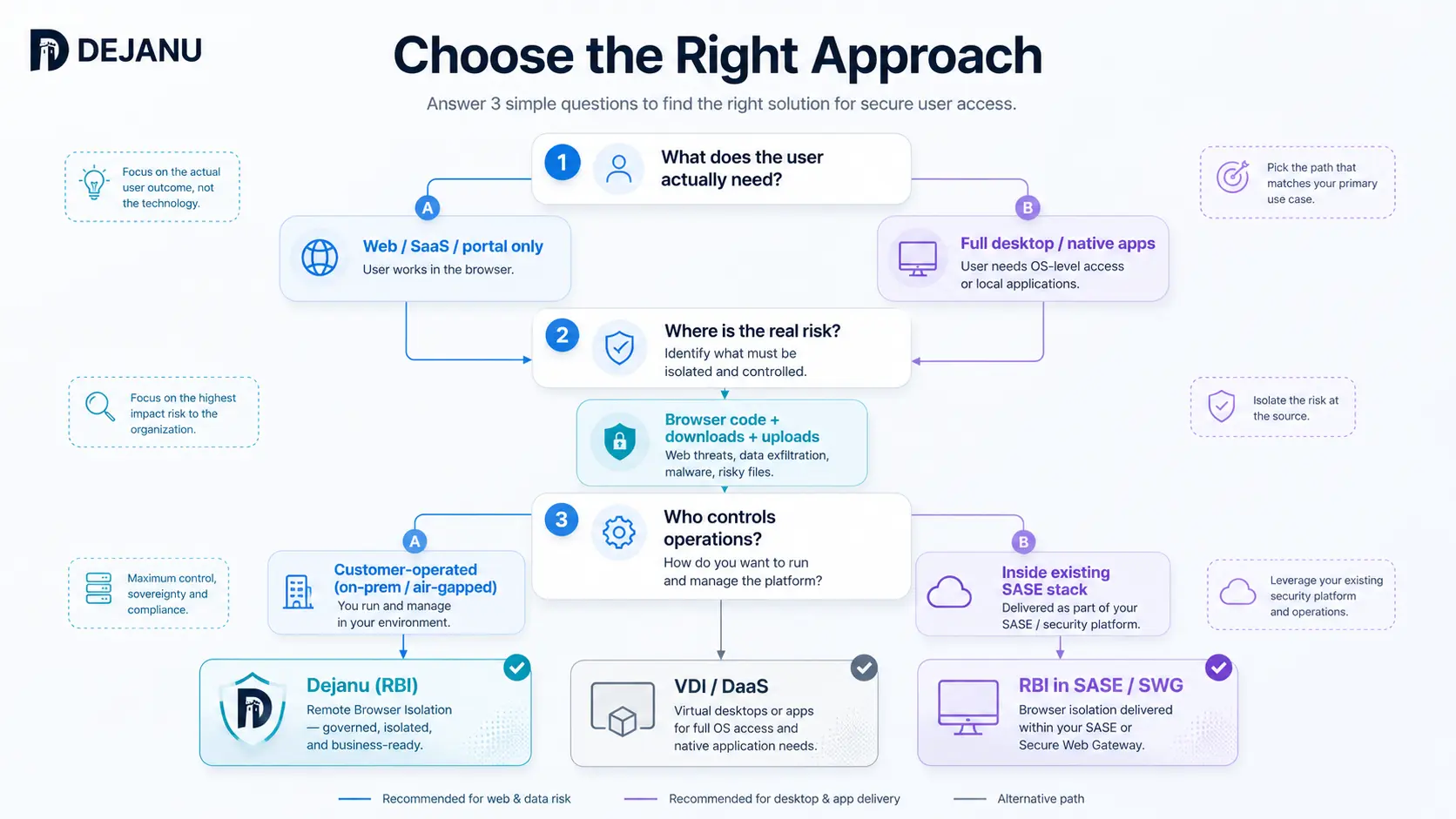
What does the user actually need?
If the user only needs a web app, SaaS portal, contractor portal, or suspicious-link workflow, Dejanu is a tighter fit than a full desktop. If they need a full desktop, native apps, or device redirection, VDI / DaaS is the better category.
Where is the real risk?
If the risk is web code execution, file download, unmanaged upload, or data movement through the browser, the browser and file path should be governed at session level. That is where Dejanu is designed to operate.
Who should control operations?
If the organization wants its own portal, policies, usage reports, recordings, and review workflow inside customer-controlled infrastructure, Dejanu matches the operating model. If everything must live inside an existing Cloud Desktop or SASE stack, that ecosystem may be enough.
Compare with your real access model.
Pilot Dejanu on one browser workflow.
30-day free pilot · 25–50 users · Architecture review included · No credit card required
Start Free Pilot